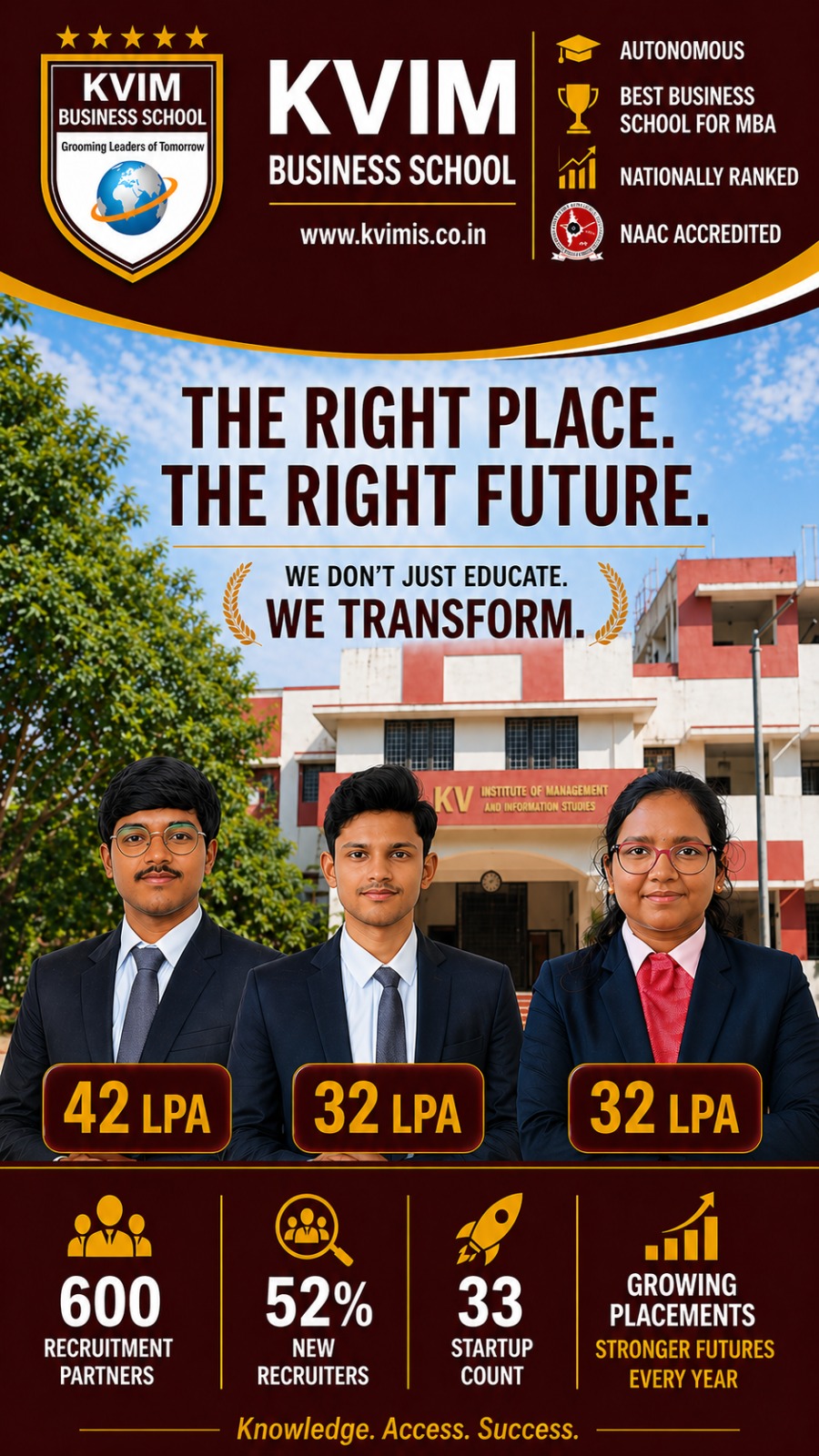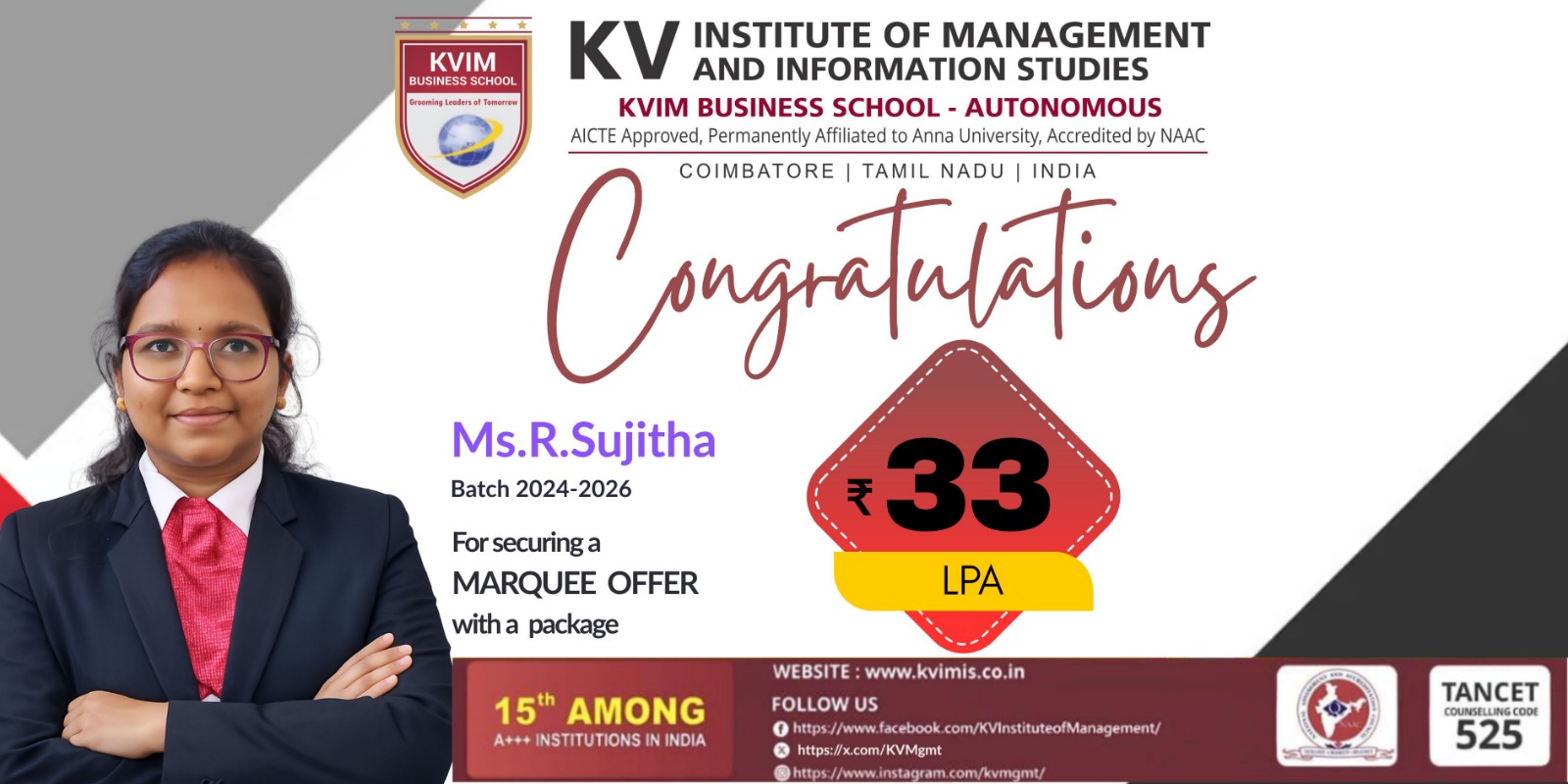





KV Institute of Management and Information Studies (KVIM), Coimbatore offers a specialized 2-Year MBA Entrepreneurship Development program designed for aspiring entrepreneurs and startup founders. As an AICTE-approved management institution and an accredited MBA institution, KVIM is widely known for its consistent placement track record under the AI-based MBA with 100% placement model and strong placement support in Coimbatore, delivering successful outcomes in management education.
The MBA fee structure at KVIM is affordable, making it a value-for-money MBA choice for students planning MBA Admission 2025 and aiming to build a strong career in India. With an industry-ready curriculum focused on innovation, leadership, and enterprise creation, the MBA Entrepreneurship Development program at KVIM continues to be a preferred choice for students seeking entrepreneurial and startup-oriented management education.
What is MBA Entrepreneurship Development?
The MBA in Entrepreneurship Development is a two-year postgraduate program designed to equip students with the knowledge, skills, and mindset required to build, manage, and scale new business ventures and technology-driven startups. The program emphasizes new venture creation, innovation management, startup finance, business modelling, design thinking, leadership development, and growth strategies. Graduates of this program can pursue careers in startups, family-owned businesses, incubation and innovation centers, venture capital firms, government-supported innovation initiatives, consulting organizations, fintech ventures, and corporate new-venture divisions. With India emerging as one of the fastest-growing startup ecosystems globally, the program supports the creation of sustainable enterprises and long-term leadership careers.
Semester Structure
Semester 1 – Foundation for Management
The first semester focuses on developing strong managerial fundamentals aligned with the curriculum followed across various MBA programs. Students are trained in statistics for management, management concepts and organizational behavior, managerial economics, accounting for decision making, legal aspects of business, and information management. The curriculum also includes a non-functional elective such as entrepreneurship management or event management, along with contemporary business communication conducted as a laboratory course and Indian ethos and business ethics delivered through seminar-based learning.
Semester 2 – Core Functional Areas of Management
In the second semester, students gain comprehensive exposure to core business functions essential for managerial and entrepreneurial success. The subjects covered include applied operations research, business research methods, financial management, human resource management, operations management, business analytics, and marketing management. Practical orientation is strengthened through data analysis and business modelling laboratories, along with a creativity and innovation laboratory. These semesters are common across multiple MBA programs and follow a unified curriculum framework.
Corporate Exposure & Practical Learning
To ensure hands-on industry exposure and practical application of concepts, KVIM integrates multiple experiential learning components into the program. Students participate in industrial visits, mini consulting projects, CI³ ultra short-term projects in collaboration with more than 150 local MoU partners, and corporate guest lectures by industry professionals. A structured summer internship programme conducted after Semester 2 further enhances real-world understanding. This practical approach prepares students for leadership roles in entrepreneurship, venture management, and global business environments.
Semester 3 – Entrepreneurship Development Specialization
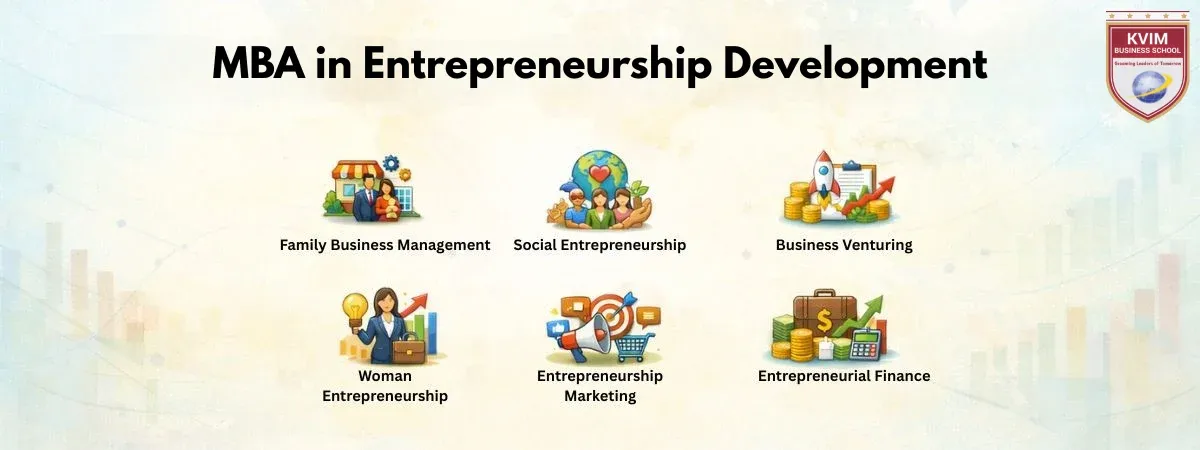
The third semester allows students to specialize in entrepreneurship-focused subjects that deepen their understanding of venture creation and innovation. The curriculum covers enterprise and new business venturing, business model innovation, social entrepreneurship, entrepreneurial marketing, entrepreneurial finance, family business management, intellectual property rights, rural and women entrepreneurship, project formulation and feasibility analysis, social business model design, and managing technology commercialization and innovation.
Semester 4 – Project Work
The final semester is dedicated entirely to project work, enabling students to apply entrepreneurial frameworks, startup methodologies, and innovation strategies to real-time business challenges and venture development scenarios. This capstone project strengthens analytical thinking, problem-solving skills, and practical decision-making.
Placement Preparation
Placement training begins in Semester 1 and continues through Semester 3 with structured sessions focused on aptitude and logical reasoning, communication and leadership development, interview readiness, resume building, and corporate skill enhancement programmes. Students enrolled in the MBA Entrepreneurship Development program also participate in KVIM Super Speciality Classes, which provide advanced training beyond the regular syllabus. This additional exposure strengthens employability and supports successful placements through KVIM’s well-established placement support system, recognized for delivering strong placement outcomes in management education.